My orchestrator was eating my tokens
·3 min read
Part 2 of 5 in My AI workflow, so farIt took me about a week to realize two of my own posts were connected.
In AI Question Fatigue, I wrote about having one Claude Code session act as an orchestrator. Every other session reports in to it, and it feeds me the questions. In I'm over my token limit... again, I wrote about hitting my weekly limit.
I'm pretty sure the first was feeding the second. It's a little embarrassing to admit.
What one question costs
The convenience is real. Every question comes to me in one place, with context.
But follow a single question through the system.
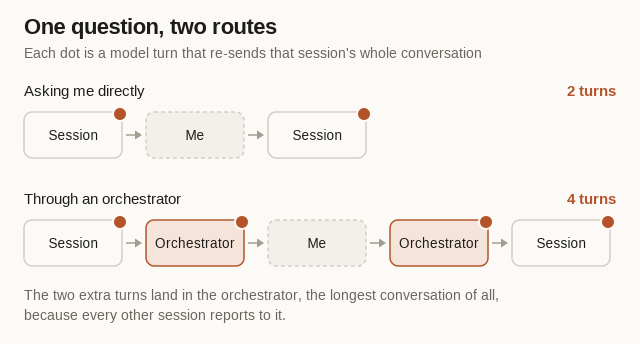 Every model turn sends that session's whole conversation again, mostly at the cheaper cached rate. Diagram made with Claude, based on Anthropic's Claude Code documentation.
Without the orchestrator, a session asks me a question and I answer. Two turns.
With it, the question goes to the orchestrator first. It has to read the question, think about where it goes, and ask me. When I answer, it has to read my answer, work out which session it belongs to, and send it back. Then that session brings it into context again. Four turns instead of two.
The two extra turns happen in the most expensive place. The orchestrator hears from every other session, a good dozen on an average day and sometimes more, so its conversation gets long fast.
Anthropic's documentation lists messages from other sessions as one of the reasons usage climbs. When a session is idle, an incoming message starts a new turn.
This isn't a new problem
I asked Claude to help me research this, and it turned up facts I never would have found on my own.
More agents talking to each other means more tokens. Anthropic found its multi-agent research system used about 15 times as many tokens as a normal chat. The Claude Code docs say agent teams use about 7 times more than a standard session.
Why it took me a week
It's hard to see where your tokens go.
/usage in Claude Code shows my plan limits and breaks recent usage down by skills, subagents, plugins and MCP servers. The docs say those figures are approximate and only cover this machine. Claude couldn't find anything that shows what cross-session messages cost, or which of my sessions is spending the most.
I'm not the first person to run into this. Claude also pointed me to ccusage, a tool Simon Willison wrote about in July 2025. It exists because people wanted to see their own usage more clearly, and it has thousands of stars on GitHub.
What I'm changing
I still think there's a place for orchestration. But I need to rethink how I use it.
What I've changed so far:
- Batching my answers instead of relaying them one at a time.
- Turning down the effort on the main orchestration session, and moving most other sessions to Sonnet.
One more to look into: Claude Code has a setting (crossSessionInbound) that holds incoming messages instead of waking an idle session for each one. I haven't checked it yet.
In I'm over my token limit... again, I listed a lot of variables that keep changing. I missed one: my own workflow. This time the change that cost me was mine.
For now, I like what orchestration gives me, so I'm sticking with it. With a few tweaks, the benefits seem to outweigh the costs.
Tagged ai, claude-code, tokens, orchestration